

Emergency Vehicle Accidents: Understanding Your Rights After Police, Fire, and Ambulance Crashes
February 25, 2026
Emergency responders protect the public — but when a police cruiser, fire truck, or ambulance is involved in a collision, the injuries can be catastrophic. These cases involve lights and sirens rules, municipal immunity, and complex liability questions, making them very different from ordinary motor vehicle accidents.
At LFK Law Practice, P.C., we investigate emergency vehicle accidents and help victims understand their rights under state and municipal law.
Police, Fire, and Ambulance Crashes
Emergency vehicle crashes often occur during:
- High-speed police pursuits
- Fire engine responses at intersections
- Ambulance transports involving injured or ill patients
- Non-emergency use of emergency vehicles
- Unsafe lane changes, overtakes, or U-turns
- Failure to secure tools, hoses, or equipment on fire trucks
Even when responding to emergencies, drivers must operate with “due regard” for the safety of all road users. Accidents involving pedestrians, cyclists, other drivers, or passengers inside the emergency vehicle can all result in claims.
Sources:
- New York Vehicle & Traffic Law (VTL) §1104 — Rules for emergency vehicles
- National Highway Traffic Safety Administration (NHTSA) — Emergency vehicle crash data
- U.S. Fire Administration (USFA) — Fire department vehicle safety reports
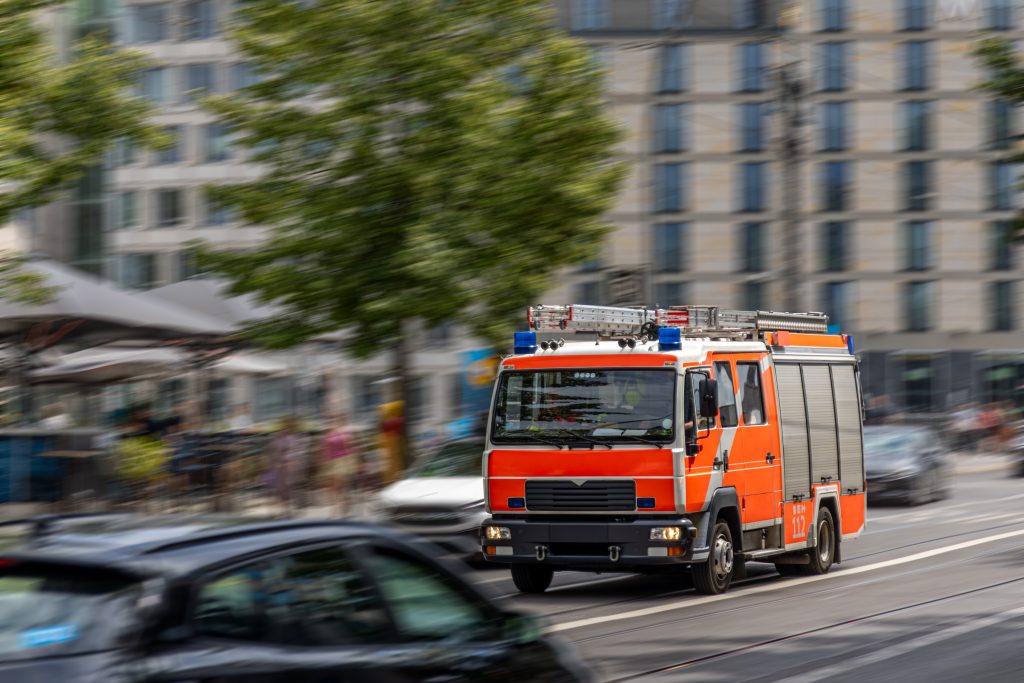
Lights and Sirens Regulations

Emergency drivers may lawfully disregard certain traffic laws only if they comply with strict warning protocols. To claim special driving privileges, an emergency responder typically must:
- Use both lights and sirens when responding to an emergency
- Slow down before entering a red light or stop sign
- Ensure intersections are clear before proceeding
- Follow departmental pursuit and emergency response policies
- Avoid reckless or dangerous operation
If an emergency vehicle was speeding, running red lights, or making dangerous maneuvers without lights and sirens activated, the municipality could be held liable.
Sources:
- VTL §1104(c) — Duty to drive with due regard for the safety of all persons
- NY State Police Pursuit and Emergency Vehicle Operation Guidelines
- NFPA 1500 — Standard on Fire Department Occupational Safety & Health
Municipal Immunity Issues
Claims involving police, fire, or EMS vehicles often involve government immunity defenses, meaning victims must overcome special legal hurdles.
These cases often include:
- Short deadlines — A Notice of Claim must usually be filed within 90 days
- Reckless disregard standard — Higher than ordinary negligence
- Immunity for discretionary decisions (e.g., pursuit decisions)
- Limitations on damages or liability caps
- Immunity exceptions for non-emergency conduct
A municipality may be liable if:
- The driver acted with reckless disregard
- The vehicle was not responding to an emergency
- Policy violations contributed to the crash
- The city failed to train or supervise the driver
- Vehicle maintenance was inadequate
Properly identifying the right immunity standard is critical for a successful claim.
Sources:
- General Municipal Law §50-e — Notice of Claim requirements
- General Municipal Law §205-e / §205-a — Liability involving police and firefighters
- Court of Appeals: Saarinen v. Kerr, 84 N.Y.2d 494 (1994) — “Reckless disregard” standard
- NYC Comptroller — Claims Reporting Guidelines

Third-Party Liability

Emergency vehicle crashes often involve multiple negligent parties, not just the emergency driver or the municipality.
Other responsible parties may include:
- Drivers who failed to yield to emergency vehicles
- Drivers who abruptly stopped, blocked intersections, or changed lanes
- Construction companies that created road hazards or restricted visibility
- Manufacturers of defective lights, brakes, or siren systems
- Dispatchers who provided unsafe or unclear routing
In many cases, comparative negligence applies — meaning multiple parties share fault and compensation may come from more than one insurance source.
Investigating third-party liability may require:
- Reviewing dashcam and bodycam footage
- Examining dispatch logs
- Analyzing vehicle maintenance and repair records
- Accident reconstruction and roadway analysis
Sources:
- NHTSA Traffic Safety Facts — Emergency Vehicle Safety
- Federal Highway Administration (FHWA) — Work zone safety guidelines
- National Institute for Occupational Safety and Health (NIOSH) — Emergency vehicle incident investigations
How LFK Law Practice, P.C. Can Help You
If you were injured in a police, fire, or ambulance crash, don’t navigate the complex immunity laws alone. Contact LFK Law Practice, P.C. today for a free consultation and learn how we can protect your rights and pursue the compensation you deserve.
Frequently Asked Questions
Can you sue a city for an accident caused by an emergency vehicle?
Yes. Municipalities can be held liable when an emergency driver acts with reckless disregard or when the vehicle was not responding to an emergency. However, a Notice of Claim must typically be filed within 90 days.
Do emergency vehicles have to use lights and sirens?
To claim certain driving privileges — such as proceeding through red lights — they must generally use both lights and sirens. Failure to activate them can be strong evidence of negligence.
Can passengers inside an ambulance or police car file a claim after an accident?
Absolutely. Passengers, including patients in ambulances or detained individuals in police vehicles, can recover damages if the emergency vehicle was operated unsafely.
Is it harder to win a case involving a police or fire truck crash?
These cases are more complex due to immunity rules and higher negligence standards. However, victims can still win if evidence shows reckless driving or policy violations.
What if another driver caused the emergency vehicle to crash?
You may be able to pursue third-party claims against civilian drivers, contractors, or manufacturers whose negligence contributed to the collision.
How long do I have to file a claim?
Claims against municipalities have shorter deadlines than normal cases. A Notice of Claim must often be filed within 90 days, followed by a one-year-and-90-day statute of limitations.